
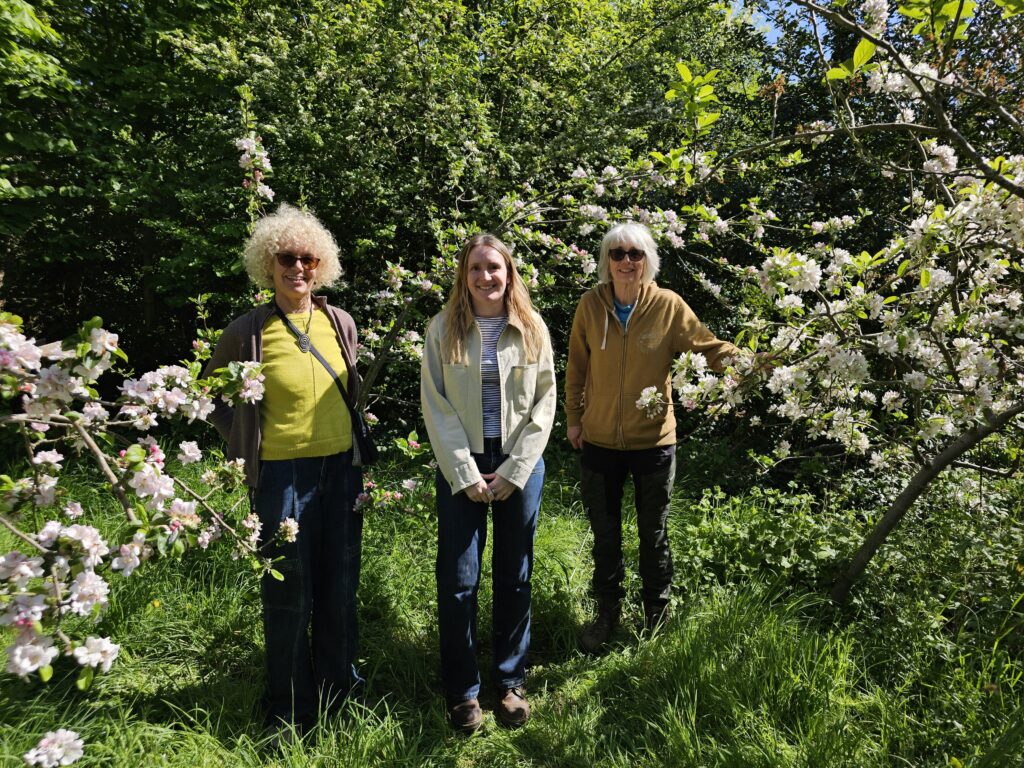
The John Innes Foundation has purchased a small heritage orchard in Merton, close to the former home of John Innes, safeguarding a collection of fruit trees with a remarkable connection to the history of the John Innes Horticultural Institution.
Tucked away on a small triangular plot in the London Borough of Merton is an unusual collection of fruit trees. Many are varieties developed through research at the John Innes Horticultural Institution (JIHI), now the John Innes Centre, and their names provide a clue to their origins: many carry the prefix ‘Merton’.
In Spring 2026, the John Innes Foundation purchased the orchard, helping to safeguard this living connection with the early history of John Innes research and opening up possibilities for its future as an educational and community resource.
Research into the genetics of fruit began after JIHI was founded in Merton in 1910 and continued until 1982 at what is now the John Innes Centre in Norwich. The primary aim was to understand the genetics of fruit crops. M. B. Crane and fellow scientists carried out studies into suitable pollination partners, leading to the publication of The Fertility Rules in Fruit Planting in the 1950s, while their work was also exhibited at the Festival of Britain in 1951. From the 1950s, research increasingly focused on breeding fruit for disease resistance.
Over more than 50 years, John Innes researchers named around 13 varieties of apple, eight varieties of pear, 19 varieties of cherry and three varieties of plum. Several can still be bought today, while others survive only through grafting from trees held by the National Fruit Collection. Some have been lost to history altogether. The Merton Orchard preserves examples of this horticultural legacy.
The orchard itself owes its existence to Merton Park resident David Channon, who lived and worked in the area for more than 40 years. David had become fascinated by the history of Merton Park and the story of John Innes. While helping to enhance the nearby Green Walk, a small plot of land came up for sale. He saw an opportunity both to improve local biodiversity and to preserve something of the John Innes legacy in the area.
He cleared the brambles and began sourcing fruit trees developed by the John Innes Institute, even grafting some himself. The first trees were planted in 2011 and, over time, the plot became a home for varieties with links stretching back to the early decades of John Innes research.
The orchard’s history stretches back further still. The triangular plot was left over from the construction of the railway line to Croydon and, during the Second World War, the land was used as allotments as part of the ‘Dig for Victory’ campaign.
After relocating to Devon, David was no longer able to manage the orchard himself. He was keen to see it placed in safe hands and hoped that his original ambition of promoting heritage fruit varieties and holding open days could continue. Its purchase by the John Innes Foundation brings the orchard into the care of the Foundation that carries forward John Innes’ legacy, providing a fitting new chapter in its story.
Work is already underway to care for the orchard and plan for its future. Caroline and Anne from the John Innes Centre (pictured above with Shannon Woodhouse, JIF Education manager) have been helping to identify and map the collection, and permanent labels have now been installed so that the different heritage varieties can be identified. There is also a plan to add further trees and, where possible, build towards a more complete collection of the fruit varieties developed at Merton.
The orchard is also home to an apiary, cared for by local beekeepers. Alongside the heritage fruit trees, the bees enhance the site’s biodiversity and add to its potential as a place where people can learn about plants, pollination and the natural world.
JIF is also working with Community Orchard Project South East (COPSE), a social enterprise specialising in the creation and enhancement of community and traditional orchards, to help develop plans for the restoration and future management of the site.
There is still work to do, but the ambition is to restore the orchard sensitively while preserving what makes it special, and to develop it as an educational resource and community asset. In doing so, JIF hopes to give this small corner of Merton a new future, not simply as a reminder of the history of John Innes research, but as a living piece of that history, still growing in the place where the story began.