
John Innes Foundation funding is helping researchers at Norwich Research Park take their knowledge beyond the laboratory, building the skills and connections they need to engage with the public and bring scientific evidence into policymaking.
Scientific research has the potential to change lives, inform decisions and help address some of society’s biggest challenges. But producing good evidence is only part of the story. Researchers also need to be able to explain their work clearly, contribute confidently to public debate and make their evidence accessible to the people making decisions.
That is why the John Innes Foundation has supported Sense about Science to deliver a programme of public and policy engagement for researchers at Norwich Research Park during 2026.
The programme has ranged from helping early-career researchers find the confidence to speak publicly about science, to specialist training in communicating with policymakers. It has also created opportunities for Norwich research to be taken directly into Parliament.
Finding the confidence to speak up for science
In May, 26 early-career researchers from 13 institutions came together at Norwich Research Park for a Standing up for Science workshop, part of Sense about Science’s Voice of Young Science programme.
Researchers heard directly from scientists, journalists, communications specialists and policy professionals about what makes effective science communication. They explored some of the challenges researchers can face when talking publicly about their work – from explaining uncertainty to responding to misinformation – and considered practical ways to become more involved in conversations about science and evidence.
After the workshop, 70% of participants said they were more likely to get involved in public conversations about science and evidence, while 62% said they were more likely to challenge misinformation. Some planned to start writing blogs or posting about their research, while others intended to seek opportunities through their institutional communications teams.
One participant described the workshop as providing both insight into communicating with the media and policymakers and the “confidence to actually put my work out there.”
Turning research into evidence policymakers can use
A second part of JIF’s support focused specifically on the relationship between research and policymaking.
Twenty-one early-career researchers from organisations across Norwich Research Park took part in specialist training designed to demystify the policy process and show researchers how and where their expertise can contribute.
A key part of the training was learning how to turn complex research into a short, accessible policy briefing. Rather than assuming policymakers have the time or specialist knowledge to read an academic paper, researchers learned how to identify the most important messages from their work and explain why they matter.
Five researchers were selected to receive individual coaching around their own research, covering subjects including crop disease resistance, food nutrition and antimicrobial resistance.
Following the initial training, 84% of respondents said they had a better idea of how to get their research into policy, and 63% said they were more likely to become involved in policy engagement.
From Norwich to Westminster
The value of connecting researchers and policymakers was demonstrated particularly clearly at Evidence Week 2026, Sense about Science’s annual event in Parliament.
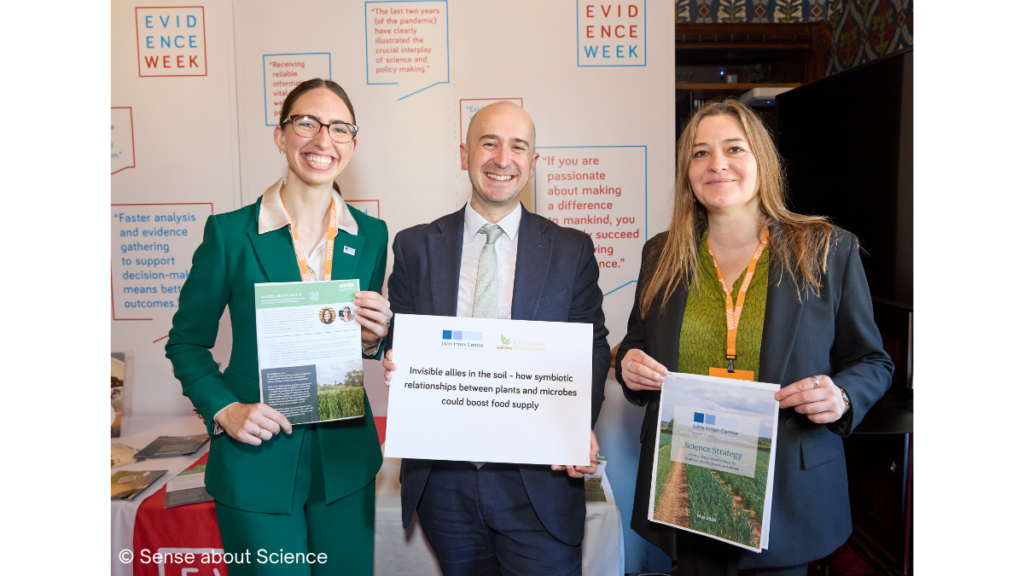
With support from JIF, John Innes Centre PhD researcher Eloise Maher and her group leader, Professor Myriam Charpentier (pictured above with Ben Goldsborough MP), took research into the relationships between plants and beneficial soil microbes directly to Westminster.
Their work explores how understanding these natural relationships could ultimately help agriculture maintain crop yields while reducing reliance on fertilisers, an important issue for both food security and more sustainable farming.
Before the event, Eloise received one-to-one coaching to help her turn the research into an accessible policy briefing and a three-minute video. At Westminster, she and Professor Charpentier discussed their research with 11 MPs, peers and other policy attendees, including parliamentary and policy professionals, answering questions and explaining why the evidence matters.
For Eloise, it was an opportunity to experience first-hand how research and policy can connect. She described it as a “fantastic experience to connect scientific research with real-world policy discussions.”
The connections made can continue beyond the event: the JIC team now has details of the policymakers they met, alongside the policy briefing and video that can be used to support future engagement.
Extending the impact of science
For the John Innes Foundation, supporting excellent research is only part of achieving lasting impact. Researchers also need opportunities to share their knowledge, engage with wider society and ensure that robust scientific evidence is available to inform important decisions.
Through its support for Sense about Science, JIF is helping researchers develop these skills early in their careers, giving them greater confidence to engage with the public, communicate with policymakers and make their expertise heard beyond the research community.
From giving early-career researchers the confidence to speak publicly about their work to creating opportunities for research from the John Innes Centre to be discussed directly in Parliament, the programme shows how targeted support can help scientific evidence travel further and reach the people who can use it.