
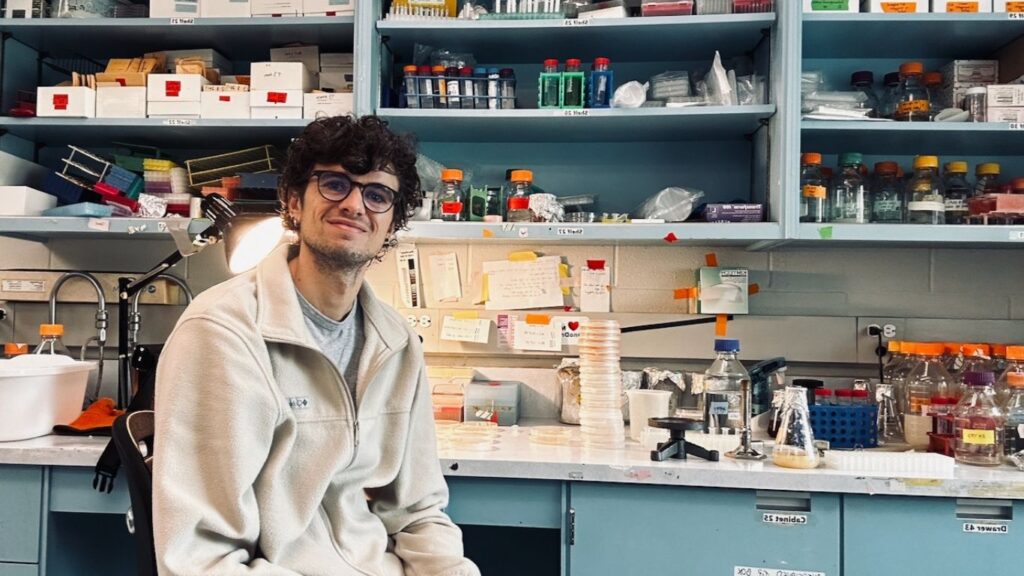
The John Innes Foundation is pleased to support the appointment of Dr James Bradley as a John Innes Foundation Fellow at the John Innes Centre, where he will establish his independent research programme in late 2026.
Currently an early-career post-doctoral researcher at the University of Toronto, Dr Bradley will join the institute in November, investigating how plants communicate with other organisms through small molecule signals, with a specific focus on plant parasites and plant fungal interactions.
In exploring these biological relations, vital to the future of sustainable agriculture, his approach integrates multiple disciplines including chemical biology, molecular genetics, population genomics, and cell biology.
“The John Innes Centre is a global leader at the interface of plant and microbial sciences, and such an inspirational place for me to take my research to the next level,” said James.
“I am excited by the opportunity to work in an environment where high-quality expertise in genetics, plant biology, microbiology and crop improvement converges to enable innovative and transformative science,” he added.
Plants interact with fungi throughout their lifecycle, forming a range of associations that can be either detrimental or beneficial. Some fungal pathogens can devastate crops, while other fungi establish mutualistic partnerships that enhance nutrient uptake and stress resilience.
These interactions are shaped by chemical signals exchanged between plant and fungal partners.
Understanding the complex chemical language that coordinates these interactions will inform strategies to limit fungal disease, while promoting beneficial fungal partnerships that contribute to more sustainable agricultural systems.
The Bradley group will focus on uncovering the mechanistic basis by which plant-derived chemical signals are perceived by fungi and translated into ecological processes.
The group’s multidisciplinary approach will use established model systems, particularly Saccharomyces cerevisiae (yeast) and Arabidopsis thaliana.
In parallel, Dr Bradley will aim to develop new laboratory models of filamentous fungi which can be studied using modern genetic approaches.
“Ultimately, my goal is to decode and harness plant-fungal chemical communication to inform innovative, sustainable strategies for crop improvement,” he said.
Dr Bradley already has some important career milestones behind him. During his PhD at Sheffield University, he contributed to the first genome assembly of one of the most agriculturally damaging species of the plant parasite genus Striga (Striga hermonthica), providing a valuable resource for understanding the genomic basis of parasite virulence.
At the University of Toronto, he pioneered the use of the eukaryotic model Saccharomyces cerevisiae as a platform to investigate how fungi perceive a group of plant-derived compounds called strigolactones. This work led to the discovery that strigolactones modulate phosphate metabolism in fungi and opened exciting new avenues for understanding how beneficial soil fungi acquire and transfer the important nutrient phosphate to plants.
Professor Cristóbal Uauy, Director of the John Innes Centre, said:
“We are delighted to welcome James to our vibrant scientific community. His cutting-edge research addresses fundamental biological questions that will drive discoveries to improve crop resilience and sustainability. James’ work is truly inspiring, and we look forward to synergies with researchers at JIC and beyond. We are also indebted to the John Innes Foundation for their visionary support into this fascinating and impactful area of science.”
The John Innes Foundation is a charitable organisation that supports plant and microbial science through funding research, education, training and public engagement at the John Innes Centre and across the wider scientific community.
Peter Innes, Chair of the John Innes Foundation, said:
“The John Innes Foundation is unequivocally committed to backing the best and most talented researchers working in fields that will further agricultural sustainability. We’re delighted to be supporting James and this new fellowship at the John Innes Centre, and will follow his research with interest and enthusiasm.”